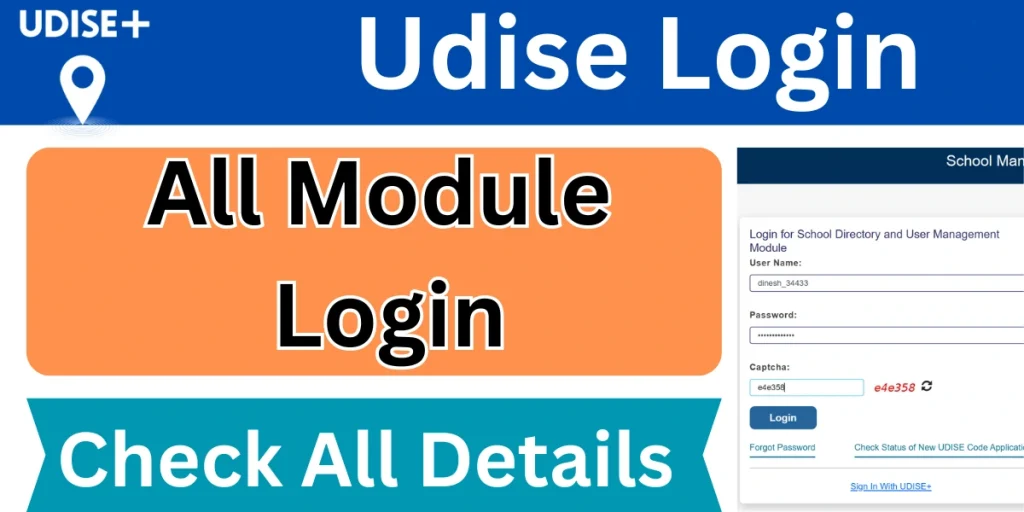
The Unified District Information System for Education (UDISE) is India’s national education data collection and management system for schools. It plays a vital role in tracking, monitoring, and improving the school education system across the country. Introduced to create a single, reliable source of school-related data, UDISE covers all recognized schools from pre-primary to senior secondary level, including government, government-aided, and private institutions.
UDISE provides structured and standardized data that supports evidence-based planning, policymaking, and evaluation of educational programs at district, state, and national levels. Over the years, it has become the backbone of India’s school education data ecosystem.
Evolution of UDISE
Before UDISE, education data in India was collected through multiple disconnected systems, making analysis difficult and often unreliable. To address this issue, UDISE was launched in 2012–13, merging different data systems into one unified platform.
To further enhance transparency, accuracy, and efficiency, the Government of India introduced an upgraded digital version called UDISE Plus (UDISE+) in 2018–19. This transition marked a major shift from manual, paper-based data collection to a fully online and real-time system.
UDISE+ is now managed by the Department of School Education and Literacy, under the Ministry of Education, Government of India.
What Is UDISE Plus (UDISE+)?
UDISE+ is the advanced digital version of UDISE that enables schools to submit data online through a centralized portal. It ensures:
- Real-time data entry
- Multi-level verification
- Improved data accuracy
- Annual data freezing to prevent manipulation
Every school registered under UDISE+ is assigned a unique 11-digit UDISE code, which acts as the official identity of the school across all government education platforms.
Objectives of UDISE
The main objectives of UDISE are:
- To create a reliable and comprehensive database of schools in India
- To support data-driven educational planning and policy formulation
- To monitor access, equity, and quality in school education
- To track student enrollment, retention, and dropout trends
- To improve transparency and accountability in the education system
Importance of UDISE in Indian Education
Data-Driven Decision Making
UDISE enables policymakers to make informed decisions based on accurate data. Whether it is teacher recruitment, infrastructure development, or student welfare schemes, UDISE data forms the foundation of planning and budgeting.
Monitoring Educational Progress
The system helps track progress across key indicators such as enrollment ratios, dropout rates, gender parity, teacher availability, and infrastructure facilities.
Supporting National Education Policy (NEP) 2020
UDISE+ plays a critical role in monitoring the implementation of NEP 2020, which focuses on universal access, quality education, and equitable learning opportunities
How UDISE Plus Works?
The functioning of UDISE+ follows a structured workflow:
1. School Registration and UDISE Code
Each school is registered on the UDISE+ portal and assigned a unique UDISE code. This code is mandatory for accessing government schemes and reporting official data.
2. Annual Data Collection
Schools fill out the Data Capture Format (DCF) every academic year. This includes detailed information about the school, students, teachers, and facilities.
3. Multi-Level Verification
Data submitted by schools is verified at multiple levels:
- Block or Cluster level
- District level
- State level
Only after verification is the data finalized.
4. Data Freezing and Reporting
Once verified, data is frozen for that academic year and used for generating reports, dashboards, and statistical publications.
Key Data Collected Under UDISE
School Profile Data
This includes:
- School name and location
- Management type (government, private, aided)
- Medium of instruction
- Availability of classrooms and laboratories
- Facilities such as drinking water, toilets, electricity, and libraries
Student Data (SDMS)
UDISE+ captures detailed student information, including:
- Enrollment by class and gender
- Attendance details
- Social category data
- Promotion, repetition, and dropout status
Teacher and Staff Data
This module records:
- Number of teachers and non-teaching staff
- Educational qualifications
- Professional training
- Subject-wise teacher deployment
Infrastructure and Facilities
Data related to:
- Playground availability
- Computer and internet access
- Smart classrooms
- Barrier-free access for students with disabilities
Know Your School Feature
UDISE+ offers a public tool called Know Your School, which allows users to search for schools using:
- School name
- Location
- UDISE code
This feature provides basic information such as enrollment numbers, teacher strength, and infrastructure availability, promoting transparency and public awareness.
Benefits of UDISE
Benefits for Government and Policymakers
- Accurate baseline data for education planning
- Identification of regional disparities
- Efficient allocation of funds and resources
- Monitoring of scheme implementation
Schools and Teachers
- Simplified online reporting
- Better visibility of school requirements
- Support for grants, recognition, and infrastructure development
Parents and Communities
- Access to reliable school information
- Increased transparency
- Better decision-making regarding school selection
Researchers and NGOs
- Availability of large-scale, standardized data
- Support for education research and impact studies
Role of UDISE in Government Schemes
- Samagra Shiksha Abhiyan
- Mid-Day Meal Scheme
- Free textbooks and uniform distribution
- Scholarship and incentive programs
Without UDISE registration and updated data, schools may become ineligible for many government benefits.
Challenges in UDISE Implementation
Data Accuracy Issues
In some cases, incorrect or incomplete data entry by schools affects the reliability of reports. Continuous training and awareness are required to address this.
Technical and Connectivity Problems
Schools in remote areas may face internet connectivity issues, leading to delays in data submission.
Administrative Delays
Multi-level verification can sometimes slow down the finalization of data, especially in large states with many schools.
Measures to Improve UDISE Effectiveness
To overcome these challenges, the government has introduced:
- Online training modules for school authorities
- Automated validation checks in the portal
- GIS-based school mapping
- Integration with other digital education platforms
These steps are aimed at improving data quality and usability.
Future Scope of UDISE
- Predictive analysis to identify dropout risks
- Real-time dashboards for administrators
- Integration with digital student credentials
- Enhanced interoperability under the National Digital Education Architecture (NDEAR)
Frequently Asked Questions (FAQs)
It collects and manages nationwide school data to support planning, monitoring, and policy decisions.
It is managed by the Department of School Education and Literacy under the Ministry of Education, Government of India.
All recognized government, government-aided, and private schools from pre-primary to Class 12 must submit data.
Schools are required to update their data once every academic year through the online portal.
Correct data ensures eligibility for government schemes, proper planning, and fair resource allocation.